Your Fridge Is Full. So Why Does It Feel Like There's Nothing to Cook?
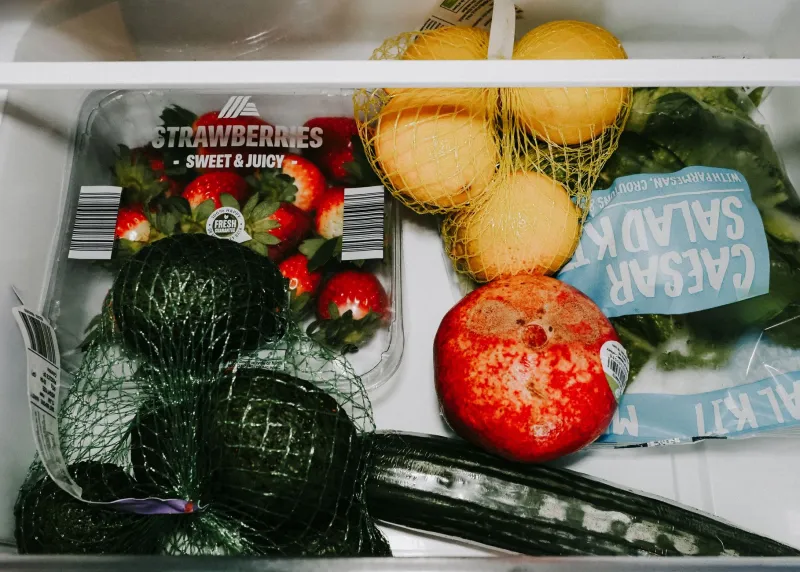
It's Tuesday evening. You open the fridge, scan the shelves, and feel that slow creep of defeat. There's half a block of tofu, some wilting spinach, a couple of eggs, two cans of chickpeas in the pantry, and a lemon that's seen better days. And yet, somehow, you're convinced there is nothing to cook.
So you open DoorDash.
This happens in kitchens all across the country, every single night—not because people are lazy or disorganized, but because the brain has a genuinely hard time working backwards from ingredients to a meal. Understanding why this happens is the first step to breaking the cycle.
The "Nothing to Cook" Problem Is Psychological, Not Practical
Researchers who study decision-making have a name for what happens when you're overwhelmed by too many possibilities without a clear framework: decision fatigue. It's the same reason you can spend 40 minutes scrolling Netflix without picking anything. Too many options with no filter leads to paralysis, not choice.
Your fridge and pantry are basically a Netflix queue with no algorithm. Without a starting point—a recipe you've already committed to, a craving, a meal plan—your brain can't efficiently sort through what's available. So instead of doing the mental work, it throws up its hands and declares the situation hopeless.
Here's the kicker: this happens even when your shelves are genuinely well-stocked. The problem isn't what you have. It's that you're asking your tired, post-work brain to generate a recipe from scratch using randomized inputs. That's a creative task, and creativity is one of the first things to go when you're running on empty.
Why Shopping for Recipes Makes the Problem Worse
The conventional wisdom around meal planning usually goes like this: pick your recipes for the week, make a grocery list, shop for exactly what you need, cook accordingly. Clean, logical, satisfying on paper.
But in practice, this approach has a serious flaw. It trains you to think of your pantry as a staging area rather than a resource. You stop seeing what's already there, because what's already there isn't "for" anything. It's just background noise.
Over time, this creates a kitchen full of half-used ingredients that never quite make it into a recipe. The tahini you bought for one specific dish. The dried lentils you've owned for eight months. The can of coconut milk that's been waiting for its moment. None of them feel like they belong to a meal—so none of them get used.
That's not a storage problem. That's a mental model problem.
Constraint-Based Cooking: The Shift That Changes Everything
Constraint-based cooking inverts the whole process. Instead of choosing a recipe and then shopping for it, you start with what you have and build from there. It sounds simple, but it requires a real mindset shift—especially if you've spent years treating grocery runs as the prerequisite to cooking.
The beauty of constraint-based cooking is that it removes the blank-page problem entirely. You're not generating a meal from nothing. You're solving a puzzle with defined pieces. And puzzles, it turns out, are much easier for the brain to engage with than open-ended creative tasks.
Chefs call this "cooking from the larder." Home cooks used to call it Tuesday. Whatever you call it, the mechanism is the same: limitation focuses attention. When you can't go buy something new, you look harder at what's in front of you—and you usually find more than you expected.
How to Actually Do This Without Losing Your Mind
The practical side of constraint-based cooking doesn't require a culinary degree or a perfectly organized pantry. It just requires a slight shift in how you approach the beginning of the week.
Do a quick inventory before you shop. Before you write a grocery list, spend five minutes noting what proteins, produce, grains, and pantry staples you already have. Not to make a meal plan around them specifically, but to make sure you're not buying duplicates of things you've already got, and to prime your brain to see those ingredients as available.
Build your weekly meals around at least 50% of what you have. This isn't about being restrictive—it's about creating connection between your existing stock and your actual cooking. Even if you shop for two or three new things, anchoring your plan to what's already on hand keeps the pantry turning over.
Keep a short list of flexible, formula-based meals. Grain bowls, stir-fries, frittatas, soups, tacos—these aren't really recipes, they're structures. When you know that a stir-fry is just protein + vegetable + sauce + grain, you stop needing a specific recipe and start seeing the ingredients in your fridge as interchangeable components. That spinach? Perfect. That tofu? Works great. The lemon? That's your acid.
Give yourself one "wildcard" ingredient per week. Buy one thing you're excited about—something fresh from the farmers market, a new sauce, whatever caught your eye. That single new element gives you variety without requiring a whole new recipe ecosystem around it.
The Waste Angle (Which Is Also a Money Angle)
Americans throw away somewhere between 30 and 40 percent of the food supply, and a significant chunk of that happens at the household level. A lot of it is the spinach that went slimy, the herbs that dried out in the bag, the yogurt that expired while you were waiting for the right recipe to use it in.
Constraint-based cooking doesn't just reduce that waste out of some abstract environmental virtue. It reduces it because it makes you actually cook what you have before it turns. When your existing ingredients are the starting point rather than the afterthought, they get used. It's that simple—and the savings add up faster than you'd expect.
The Bigger Picture
There's something quietly satisfying about opening your fridge, seeing what's there, and making something good out of it. Not because it's impressive or Instagram-worthy, but because it's competent. It's you being a functional adult who can feed yourself without outsourcing every decision to a recipe developer.
The goal of Mod Meals has always been to make weeknight cooking feel manageable rather than aspirational. And constraint-based cooking is one of the most honest expressions of that—because it meets you exactly where you are, with what you already have, and asks you to just work with it.
Your fridge isn't empty. Your approach just needed a reset.